Archives

The Treegate series by Leonard Wibberley

To celebrate the 250th anniversary of the U.S.A. and to continue a project to read ALL of the books in my library, I’m taking a journey through the decades of American history in books, reading one book for every decade from the 1770’s to the 2020’s. I already wrote about my book for the 1780’s, Colt of Destiny, but I actually started my reading journey with a series of four books from the 1770’s—Leonard Wibberley Treegate series that spans the years of the American Revolution from Lexington and Concord to the surrender at Yorktown.

The four books are:

  • John Treegate’s Musket
  • Peter Treegate’s War
  • Sea Captain from Salem
  • Treegate’s Raiders

These four books are also expansive in setting, ranging from Boston to the Carolinas to Paris and the islands of the North Sea. Many aspects of the Revolutionary War that are not usually covered in most histories and historical fiction are illuminated and dramatized in these four short, action-packed novels. The reading level is middle grade and upper elementary, but the interest level stretches from middle grade to adult. I found the ideas accessible but worth pondering for adults as well as young people.

One central conflict in the series has to do with loyalty. Is Peter Treegate, young Boston apprentice, right to pledge loyalty to the fledgling, as-yet-unformed Continental Army, or is Peter’s father right to remain loyal to the British King and country? When Peter, by a series of mistakes and escapes, ends up in the mountains of Carolina and is adopted by a fierce Scotsman, is Peter’s loyalty to his new country or to the clan? Is this new American nation’s culture to be a tribal, honor culture like the old Scottish clan system, or is it something new, based on aspects of British law but adapted to a new continent with new ideas of freedom and dignity for all people?

These questions form a thread through all four of the Treegate books as the narrative shows how Peter Treegate and his friends and family weather the turbulent times of war and violence. The books are violent, but not gratuitously so. Peter is a brave but imperfect hero in three of the books, and his friend, the fisherman Peace of God Manly, who is the central character in the third book of the series, makes for an interesting break in the story as we follow the adventures of Peace of God in his war with the British at sea.

Each of these books can stand alone, but they are more fun if read in order. In the fourth book, Peter Treegate comes into his own as a leader and a fighter. Seeing his character develop over the course of the four books is an adventure in itself, and as we follow Peter we also get an idea of how the Revolution affected the ordinary people who fought it in extraordinary ways.
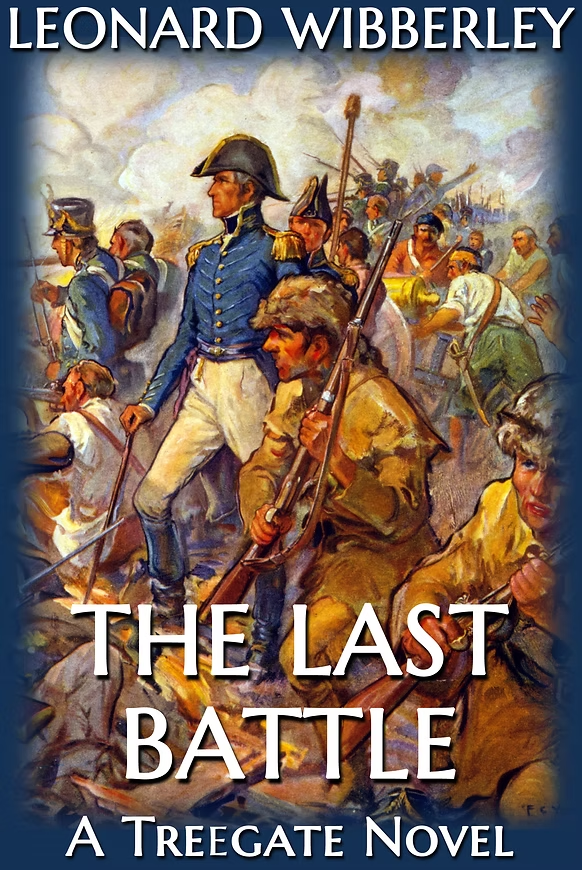
There are three more books in the Treegate series, as well as a separate Revolutionary War novel that is sometimes included as part of the series although it’s not about the Treegates at all. The three Treegate books follow the family through the War of 1812 and into the next generation of the Treegate family. The fifth through the eighth books in the series are:

  • Leopard’s Prey
  • Manly Treegate, Frontiersman
  • The Last Battle
  • Apprentice to a Revolution

I’ve ordered these latter Treegate books, and I plan to read and review them, too. Mr. Wibberley is a great writer, and I do have an additional series by the same author to recommend, the ones listed below about Thomas Jefferson. All of these books are certainly appropriate for the 250th anniversary of Declaration of Independence and the beginning of the American Revolution, including the lightly fictionalized biographical series about Thomas Jefferson:

City Spies and The Sherlock Society by James Ponti

Ponti, James. City Spies. Aladdin, 2020. Book 1 of 6 in a series by this author. Other books in the series: Golden Gate, Forbidden City, City of the Dead, Mission Manhattan, London Calling.

Ponti, James. The Sherlock Society. Aladdin, 2024. This series is new and possibly as yet uncompleted. Book #2 is called Hurricane Heist.

Because I have seen James Ponti’s middle grade novels suggested and praised in multiple places, I wanted to check them out for myself –and for possible inclusion in my library. I have only read the first book in each of the two series, but I would like to read more. So that’s my initial reaction.

City Spies, Ponti’s bestselling series starter, is indeed a good read. When Sara Martinez is sent to juvie for hacking computers, it’s really a revenge arrest initiated by her abusive foster parents. However, Sara is a computer whiz, and her hacking abilities have not gone unnoticed. A British spy, sent by M16, rescues Sara from the clutches of the New York juvenile justice system and recruits her to join a secret team of juvenile spies instead of going to jail. The City Spies are five kids from around the world who live now in Scotland, attend an elite school, and in their spare time, go on spy missions for the British Secret Intelligence Service.

It’s an intriguing set-up, and the book delivers on its premise. The City Spies, along with their handler, code name Mother, are sent to Paris to infiltrate an international youth competition on the science of rainmaking (seeding clouds and such), while they are really there to protect the reclusive millionaire who’s sponsoring the competition. And there are a few side missions and quirks and turns in the main mission such that Sara is initiated into the team in an exciting and adventurous operation. The assignment is resolved satisfactorily, but there are plenty of remaining questions about the team and its future to lead to another book (and another and another, it seems).

The writing is adequate. The plotting is the same. And the characters are interesting enough, as I said, to make me want to read at least the next book in the series. I can see why this series has gained such popularity. I have no content considerations, really, although there is a murder involved, off-stage, not explicitly described. And the kids do spy stuff: lies, deception, computer hacking, breaking into buildings, false identities–all in pursuit of catching and stopping the bad guys.

Ponti’s second series (that I read), The Sherlock Society, begins with a book not quite as exciting as City Spies, but promising. Instead of international intrigue, this one is about a group of American kids in Miami who are looking for a way to earn some money during the summer break. Babysitting is boring and mowing lawns is hot and sweaty, so Alex Sherlock and his friends Yadi and Lina, inspired by Alex’s surname and the famous predecessor of that same name, decide to start a detective agency. Then, Alex’s older sister, Zoe, and his retired journalist grandfather become involved, and the search for Al Capone’s hidden money becomes a crazy and dangerous chase after environmental polluters and current day criminals.

I liked this one almost as much as I did City Spies, but the pacing was a little off. There’s a lot of Miami history interspersed between the adventure, and any kids’ library in Florida would do well to have a copy of this book just for the history aspect. The characters in this one were fun. Grandfather is just crazy enough to be believable, and Alex’s parents are actually involved in his and Zoe’s lives and in the story, not absent, and that’s a breath of fresh air. Alex and his friends are nerdy, and lovable, and Zoe is a bit harder to get to know and love but worth it in the end. I look forward to reading Hurricane Heist soon, just in time for height of hurricane season here in Houston and in Florida.

Bletchley Park Books for Teens

The Enigma Girls: How Ten Teenagers Broke Ciphers, Kept Secrets, and Helped Win World War II by Candace Fleming.

The Bletchley Riddle by Ruta Sepetys and Steve Sheinkin.

Bletchley Park and the code breakers who lived and worked there during World War II are hot topics these days. Maybe it’s because the whole episode is less “mined” because of all the secrecy that surrounded the work there. Maybe it’s just a fleeting trend. At any rate, there do seem to be a lot of books about Bletchley floating around, but not so many for the younger set. Until now.

These two books, one fiction and one nonfiction, were recently published (2024) and are appropriate for young people about 13 years of age and up. The Enigma Girls tells the story of several teenaged girls who were recruited to work at Bletchley either because of their math skills or their language proficiency. But these girls were not, for the most part, doing the high level code breaking that was the most intriguing and intellectually challenging work going on at Bletchley Park. Rather, they were keeping records on notecards of all of the code words and German double speak that had been decoded. Or they were servicing and keeping the huge “bombes” running. These were the machines that were created to infiltrate and determine the settings for the German Enigma coding machines. Machines (or primitive computers) were fighting machines, and teenagers were keeping the machines moving and computing.

By limiting her story to the females who worked at Bletchley, gifted nonfiction author Candace Fleming risks over-emphasizing and even distorting the role that these women and girls played in the overall mission of breaking and intercepting the Nazi communications. But she doesn’t fall into that trap, and instead as I read I was moved to admire the persistence and hard work of these unsung heroines who toiled in harsh conditions doing work that they were unable to discuss or even understand completely. It wasn’t a romantic, spy-novel kind of job. The “bombes” were huge, oily, and loud, and the girls who tended them knew very little about how they worked or what significance their work might have. And after the war was over, the Enigma Girls were still left in the dark about how their work helped England win the war because they and everyone else who worked with them were bound to secrecy by the Official Secrets Acts that they all had to sign. They only knew that they were needed to “do their part” in defeating Hitler—and they did.

The Bletchley Riddle, although it is “based on the real history of Bletchley Park, Britain’s top-secret World War II codebreaking center,” makes the whole setting and story much more exciting and romantic. (Fiction can do that.) Ruta Sepetys and Steve Sheinkin, both well known in YA literature circles, wrote this spy novel together, and the joint authorship shows. It’s a bit disjointed at times, but the two authors do tie up most all of the loose ends by the end of the story. Fourteen year old Lizzie Novis has lost her mother, Willa, a single parent who works for the U.S. Embassy in London. Willa went to Poland to help evacuate tens of U.S. Embassy there in anticipation of the Nazi invasion of Warsaw. And she didn’t come back. Everyone says that Willa is dead, that she most likely died in the invasion. But Lizzie is sure that Willa is still alive, and she’s determined to find her mother no matter what it takes.

I’ll let you read to find out how Lizzie ends up in Bletchley, with several hurried trips back to London. I’ll let you read about Lizzie’s older brother Jakob, and how he becomes the other major character in the story. And finally in the pages of the book, you can meet Lizzie’s new friends, Marion and Colin, and read about a little harmless romance that springs up as they all try to keep up with the irrepressible Lizzie and her quest to find Willa. It’s a book about lying and spying and secret-keeping and persistence in a time and place where all of those qualities, even the dishonesty, are necessary for survival.

But the story never becomes too thoughtful or deep. It’s barely believable that Lizzie can get away with all of the shenanigans that she pulls. And Jakob seems too befuddled to be as intelligent as he’s supposed to be. Maybe he’s a bit of an absent-minded professor at the ripe age of nineteen. Anyway, it’s a lark, but not to be taken seriously. And the minor characters—Alan Turing, Dilly Knox, Gordon Welchman—as well as the setting provide a good introduction to Bletchley Park and its importance to the British war effort and eventual victory.

I recommend both books for those teens who are interested in World War II and Bletchley Park and codes and codebreaking. Oh, both books spend a fair amount time talking about codes and ciphers and Enigma and how it worked and how the Enigma code was broken? Or deciphered? I can never keep the difference straight in my head between codes and ciphers, much decode or decipher anything. But you may have better skills than I do.

The Pink Refrigerator by Tim Egan

Version 1.0.0

This picture book came to my attention via Tanya Arnold of Biblioguides, but I already knew and loved Dodsworth the rat. (I thought he was a mole, but he’s actually a rat.) Dodsworth and the duck are the main characters in one of my favorite easy reader series, Dodsworth in New York, Dodsworth in London, Dodsworth in Paris, etc. I had no idea that Dodsworth made his first appearance in print in The Pink Refrigerator.

Dodsworth “loved to do nothing.” “[H]is motto was basically ‘Try to do as little as possible.'” The Pink Refrigerator is the story of how Dodsworth got up, got moving, and became an adventurer, and it’s a perfect prequel of sorts to the Dodsworth and the duck books. The awakening of Dodsworth is all because of the inspiration he received from messages he found at the dump on a mysterious and rusty pink refrigerator.

I don’t want to spoil the story by telling too much more, but this one should be a classic. “Dodsworth suddenly felt a great sense of wonder about everything.” Isn’t that sense of wonder and adventure what we all want for ourselves and our children, for all of those we love? If they can learn it from a rat (mole?) named Dodsworth and a pink refrigerator, then more power to him!

“Tim Egan lives in California, where he makes a living as an illustrator and author of children’s books. Sometimes he visits the refrigerator for ideas, too. Except his refrigerator is blue.”

Read more about Dodsworth and his adventures in:

  • Dodsworth in New York
  • Dodsworth in London
  • Dodsworth in Paris
  • Dodsworth in Rome
  • Dodsworth in Tokyo

Read more about the duck in Friday Night at Hodges Cafe.

Sinclair Lewis also wrote a book called Dodsworth. Not the same Dodsworth.

I still prefer to think that Dodsworth is a mole.

This Picture Book Preschool book can be borrowed by member families from Meriadoc Homeschool Library.

Gem Books from 100 Years Past: 1924

It was indeed a different era. What was going on in 1924 when these books were being published and read? The 1924 Paris Olympics, Leopold and Loeb murders, the premiere of Rhapsody in Blue by Gershwin. Vladimir Lenin died, and Mallory and Irvine disappeared while attempting to summit Mt. Everest. Robert Frost won the Pulitzer Prize for Poetry, and crossword puzzles were all the rage after Simon snd Schuster published their first book of crosswords.

As far children’s literature was concerned, the field of books written especially for children was just coming into its own. The Horn Book Magazine, the oldest bimonthly magazine dedicated to reviewing children’s literature, was founded in Boston in 1924. The Newbery Medal for “the most distinguished contribution to American literature for children” was only a couple of years old. The medal-winning book for 1925 (published in 1924) was Tales from Silver Lands, a book of Central and South American folktales, collected and recorded by Charles Finger. Two other 1924 books were “runners-up” for the Newbery: The Dream Coach by Anne Parish and Nicholas: A Manhattan Christmas Story by New York Public Library’s head children’s librarian, Anne Carroll Moore.

Unfortunately, all three Newbery-honored books from 1924 seem to me to be not horrible, but forgettable. The South American folktales are perhaps of interest to scholars and storytellers, but I doubt the average child would glom onto them. The other two books are more the sort of books that adults think children should like than they are the kind of story that children do enjoy.

Still, 1924 was a good year for children’s books. Here’s a list, with brief annotations, of eight real gems from 1924. Several of these are not in print, but I would love to see them come back.

To see more books from 1924, with links to reviews, check out this post from the beginning of our 1924 Project.

Yugoslav Mystery by Arthur Catherall

This novel is the second or third of Mr. Catherall’s young adult novels I’ve read, and I’m beginning to get a feel for his style and genre. He reminds me of the adult spy novelists Nevill Shute or Alistair MacLean, or even Helen MacInnes, but a bit more tame with teen protagonists. I would guess that boys ages 13 to 16 would find Catherall’s novels quite intriguing.

This mystery takes place on an impoverished island off the southern coast of the former Yugoslavia. It’s several years post-World War 2, but the people who live on this island are still trying to recover from the war and all of its many depredations and consequences. One of those consequences of war is that our protagonist, Josef Piri, fourteen years old, lives with his grandfather and his mother, all of them believing that Josef’s father died in the war before Josef was born.

One day while Josef and his grandfather are out fishing, a police boat comes alongside to ask if they have seen an escaped fugitive on or near the island. Josef, in fact has and does see the escapee clinging to a rope alongside the police launch, out of sight and desperate to remain so. What is the right thing to do? Remain silent and help the man escape or give him up to the authorities?

The choice Josef makes leads him and his entire island village into quite an adventure. There are guns and hidden treasure and narrow escapes and various people who are not what they seem to be. Josef must draw again and again on his courage and his innovative ideas to protect his family and the other villagers and to understand his heritage as his father’s son.

The story takes place in Communist Yugoslavia in about 1960, and it was published in 1964. The Communist government is far away in this story, and is neither praised nor criticized. The villagers, including Josef and his family, live far from the day to day reach of the government, and their lives continue with very little government interference or help. There are a couple of mentions of government aid to the villagers, but it’s not significant. And the adventure that Josef’s encounter with the police boat and the escaped fugitive brings has little or nothing to do with Communism or Marshal Tito.

This book can be borrowed by member families from Meriadoc Homeschool Library.

Stateless by Elizabeth Wein

Having just re-read the Flambards novels by K.M. Peyton, set in the early days of flying and airplanes before, during , and after World War I, I was prepared and pleased to read another golden age of flying novel, this one set in 1937 Europe, just before World War 2 changed everything. Elizabeth Wein, author of the compelling and well written Code Name Verity, Rose Under Fire, and Black Dove White Raven (as well as a disastrously bad prequel to Code Name Verity), likes to write about female aviators, and airplanes, and flying as well as the politics and adventures surrounding the 1930’s and World War 2. In Stateless she has given us a spy and aviation thriller reminiscent of Helen MacInnes’ spy novels which is a high compliment because I am quite fond of MacInnes.

Stella North, Northie to her friends, has been chosen to represent Britain in the Circuit of Nations Olympics of the Air, Europe’s First Youth Air Race. She’s the only female flyer in the race with eleven other pilots from eleven different European countries. The race is supposed to be promoting peace and friendly relations between the peoples and nations of Europe, but with the Spanish Civil War still raging and the Nazis becoming more powerful and belligerent in Germany, peace seems somewhat elusive. And the press is no help at all, with reporters mobbing the contestants in every city they fly to and asking questions that suggest that the pilots themselves might resort to sabotaging each other’s planes to win the race. When one of the racers goes missing, and Northie has dangerous information about what happened to him, she and others begin to wonder if a murderer might be lurking among the contestants.

The themes of international and world peace and the difficulties of achieving it and of individual identity and nationality and transcending European borders are articulated, but left to simmer as the plot itself and figuring out whodunnit took up most of the space in my reading mind. I did notice that the characters were mostly multilingual and multinational with divided loyalties that were soon to tested by the outbreak of World War 2. The author in her Author’s Note at the end of the book speculates on what would happen to these young flyers in just a couple of years after 1937, but we’ll never know unless Ms. Wein decides to write a sequel.

Well plotted and exciting, this novel falls just short of brilliant. There’s the problem of why don’t Stella and the charming but volatile Tony inform the authorities of their suspicions and of what they have actually witnessed. Of course, for the sake of the story, the authorities can’t just wrap everything up, call off the race, and send everyone home. So Northie and her friends must find reasons not to tell what they know: they don’t trust anyone else. No one would believe them. They don’t have enough proof. Nonsense. If I saw what Stella saw and knew what she knew, I’d be screaming bloody murder (literally, murder!) until someone somewhere listened and believed me and did something. At least, I think I would. Anyway, if you just go with it, it’s a good story.

And it’s clean. There are one or two brief kisses, and some faked necking (standing close and pretending to kiss) while the protagonists are hiding from the Gestapo. No bad language that I recall, except for one exclamation using the word “bloody” by a British character, a word which I understand carries more weight with the Brits. There is violence, but it’s not terribly graphic. All in all, it’s a book I would be happy to recommend to older teenage and adult readers.

The Strange Intruder by Arthur Catherall

I’ve heard of Arthur Catherall as an author of children’s or young adult fiction, but I’ve always thought of him, without having read any of his books, as a sort of minor, second rate, potboiler fiction writer. Sorry, Mr. Catherall. If The Strange Intruder is a good example of the rest of Catherall’s work, he’s actually a first rate adventure writer. Maybe I had that potboiler idea because Catherall was so prolific: he wrote dozens of books using his own name and dozens more using seven different pseudonyms. Busy man.

Anyway, The Strange Intruder is a coming of age story about a sixteen year old boy, Sven Klakk, who lives on the island of Mykines in the Faroe Islands. You might need a map to locate that island exactly in your mind (I did), but it’s generally northwest of Scotland and the Shetland Islands and west of Norway, southeast of Iceland in the North Sea. In my 50 cent Archway paperback copy of the book there is a handy-dandy map, so there probably will be one in yours, too, whatever copy you end up reading.

Catherall “voyaged to the Faroe Islands, the locale of this story, and spent some time there, getting to know the islanders and their way of life.” This familiarity with the setting shows in the descriptions of not only the flora and fauna of the island, but also the way the people talk, and work, and make decisions, and form their community life. Of course, I was reminded of the TV series Shetland, with the Shetland Islands nearby, but this island Mykines in the 1960’s, is its own place with its own remote and closely bound culture and way of life.

“A reign of terror grips a storm-lashed island.” There is storm and shipwreck and peril and a big surprise that leads to even more danger and peril, and I can’t say much more for fear of spoiling the story. But just know that you won’t encounter any political agendas or preaching or morals to the story—just pure adventure and suspense and character growth and wildness. I recommend this book, and on the strength of this one, you might want to at least check out Catherall’s many other stories, too.

This book can be borrowed by member families from Meriadoc Homeschool Library.

The Pearl Lagoon by Charles Nordhoff

What are boys (and girls) reading in the way of adventure stories these days? Most of the the realistic fiction I read these days for middle grade readers is “problem fiction”: mom is sinking into depression and the child must cope with the fallout, or the main character is autistic or has a learning disability, or the bad developers are going to turn the local park into a parking lot. Nothing wrong with that, but where’s the adventure? Many young readers are into fantasy fiction, which does have the adventure element, but it’s not usually an adventure that the reader can imagine participating in himself.

Well, the novels of yesteryear for young people were full of adventure. Sure some of the adventures required a suspension of disbelief, as does this 1924 novel, The Pearl Lagoon. Nevertheless, excitement and danger used to be abundant in fiction written for young people. In The Pearl Lagoon, Charlie Selden, the protagonist and narrator, is an all-American boy of sixteen, living on a California ranch, isolated and starved for adventure, when his Uncle Harry, “a buyer of copra and pearl-shell in the South Seas,” comes along with an offer that can’t be refused. Uncle Harry wants to take Charlie back to the island of Iriatai in the South Pacific, to help him hunt for pearls in Iriatai Lagoon.

Needless to say, Charlie jumps at the chance to go with Uncle Harry, and the adventure begins. The book includes fishing trips with Charlie’s new Tahitian friend, Marama, a boar hunt, a near-deadly shark attack, some rather perilous pearl diving, exploration of a hidden cave, and a climactic encounter with pirates who intend to steal all of the pearls the divers have found. Charlie grows older and wiser over the course of a life changing and thrilling experience.

The South Sea islander characters in the story are portrayed as “noble savages.” If the musical South Pacific and other stories of that nature are offensively “colonizing” to you, then Nordhoff’s 1924 vintage portrayal of the islands and their culture and people will be, too. Charlie says of his friend Marama,

“My friend could read and write, but otherwise he had no education in our sense of the word. He knew nothing of history, algebra, or geometry, but his mind was a storehouse of complex fishing-lore, picked up unconsciously since babyhood and enabling him to provide himself and his family with food. And when you come to think of it, that is one of the purposes of all education.”

The people of Tahiti and Iriatai are described variously as natives, savages, brown, formerly heathen, and superstitious. But they are also admired for their skill, courage, honesty, and loyalty. Charlie’s uncle, like the author Nordhoff, has come to think of Tahiti as his home, “the most beautiful thing in all the world.” You can read the book and decide for yourself whether Nordhoff shows love and respect for the Tahitian and other South Sea island peoples or not. I believe he does, and I recommend the book as a stirring romantic adventure, in the best sense of the word romance. (Romance, according to Sir Walter Scott, the great romantic novelist: “a fictitious narrative in prose or verse; the interest of which turns upon marvellous and uncommon incidents.”)

The Pearl Lagoon is marvelous, and uncommon, indeed.

Out of Range by Heidi Lang

3 sisters: Abby, Emma, and Ollie McBee.

A months-long feud, trading pranks, insults, and put-downs, culminates in the girls being sent to Camp Unplugged. Their parents hope that some time together, away from internet, cell phones, and other distractions, will help the sisters to re-unite and forgive each other. But it’s not working. Abby, the oldest sister, has found a new friend at camp, and Emma and Ollie feel just as angry and left out as they did at home. So the malicious pranks–a frog in the tent, honey in the sleeping bag, and more–continue, and the girls’ camp counselor, Dana, is just as exasperated with them as their parents were.

So, Dana takes the girls on an all day disciplinary hike up a nearby mountain, and then when the three sisters are separated from Dana, they get lost and and injured. And they have to outrun a fire and navigate a raging river. And they meet a bear, and there may be a mountain lion stalking them. Can the sisters learn to work together, forgive each other, and survive?

The author shows the tangled relationships between these three sisters, their fears and their hopes and their growing pains, so well, as they trade insults and yet come to realize how much they really care for each other and need each other. It’s not an immediate or complete change that happens just because the sisters are in crisis mode. Abby is still the somewhat bossy and superior older sister, twelve years old and responsible but not sure she’s up to the responsibility. Emma is still the middle sister, ten, caught between Abby and Ollie, afraid of strong words, somewhat anxious, and longing for everything to go back to the way it was before the sisters broke up into “sides”—The Youngers against Abby. Ollie is still the baby (who isn’t really a baby any more), stubborn, impulsive, and slow to apologize. There are layers of personality and relationship and sisterhood here that are revealed a little at a time, like peeling an onion, as the three sisters come to know each other and themselves so much more deeply.

I liked this book a lot. The sisters have been rather cruel to each other, but they eventually, and realistically, find a way to forgive each other and move forward. I’m going to be recommending this books to sisters and to brothers, all siblings, who are forging their own sibling relationships, probably in less challenging circumstances than those the McBees face. I always told my kids when they were growing up that friends come and go, but family, sisters and brothers, are forever. Those sibling relationships are an important training ground for life, and sometimes they have to be mended–because we all say and do things to hurt each other.

Good book.