Archives

The Treegate series by Leonard Wibberley

To celebrate the 250th anniversary of the U.S.A. and to continue a project to read ALL of the books in my library, I’m taking a journey through the decades of American history in books, reading one book for every decade from the 1770’s to the 2020’s. I already wrote about my book for the 1780’s, Colt of Destiny, but I actually started my reading journey with a series of four books from the 1770’s—Leonard Wibberley Treegate series that spans the years of the American Revolution from Lexington and Concord to the surrender at Yorktown.

The four books are:

  • John Treegate’s Musket
  • Peter Treegate’s War
  • Sea Captain from Salem
  • Treegate’s Raiders

These four books are also expansive in setting, ranging from Boston to the Carolinas to Paris and the islands of the North Sea. Many aspects of the Revolutionary War that are not usually covered in most histories and historical fiction are illuminated and dramatized in these four short, action-packed novels. The reading level is middle grade and upper elementary, but the interest level stretches from middle grade to adult. I found the ideas accessible but worth pondering for adults as well as young people.

One central conflict in the series has to do with loyalty. Is Peter Treegate, young Boston apprentice, right to pledge loyalty to the fledgling, as-yet-unformed Continental Army, or is Peter’s father right to remain loyal to the British King and country? When Peter, by a series of mistakes and escapes, ends up in the mountains of Carolina and is adopted by a fierce Scotsman, is Peter’s loyalty to his new country or to the clan? Is this new American nation’s culture to be a tribal, honor culture like the old Scottish clan system, or is it something new, based on aspects of British law but adapted to a new continent with new ideas of freedom and dignity for all people?

These questions form a thread through all four of the Treegate books as the narrative shows how Peter Treegate and his friends and family weather the turbulent times of war and violence. The books are violent, but not gratuitously so. Peter is a brave but imperfect hero in three of the books, and his friend, the fisherman Peace of God Manly, who is the central character in the third book of the series, makes for an interesting break in the story as we follow the adventures of Peace of God in his war with the British at sea.

Each of these books can stand alone, but they are more fun if read in order. In the fourth book, Peter Treegate comes into his own as a leader and a fighter. Seeing his character develop over the course of the four books is an adventure in itself, and as we follow Peter we also get an idea of how the Revolution affected the ordinary people who fought it in extraordinary ways.

There are three more books in the Treegate series, as well as a separate Revolutionary War novel that is sometimes included as part of the series although it’s not about the Treegates at all. The three Treegate books follow the family through the War of 1812 and into the next generation of the Treegate family. The fifth through the eighth books in the series are:

  • Leopard’s Prey
  • Manly Treegate, Frontiersman
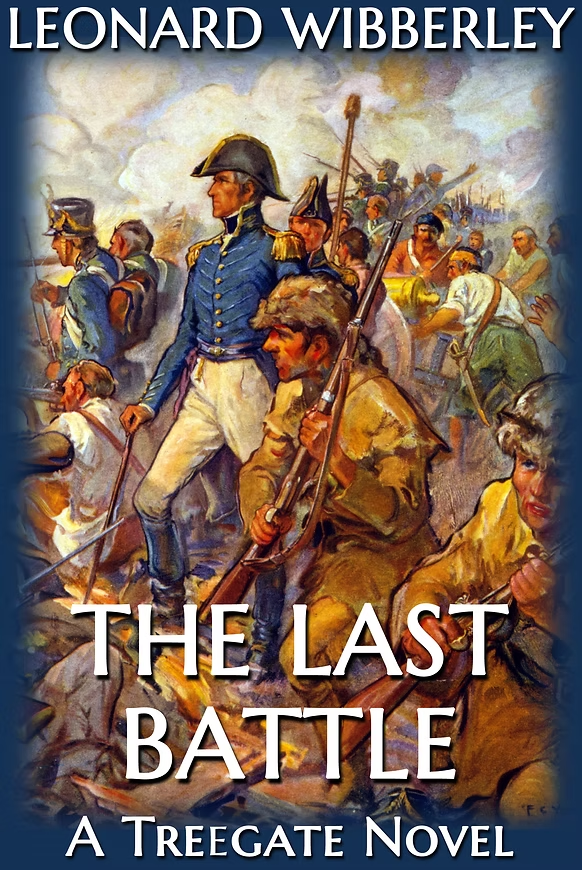
  • The Last Battle
  • Apprentice to a Revolution

I’ve ordered these latter Treegate books, and I plan to read and review them, too. Mr. Wibberley is a great writer, and I do have an additional series by the same author to recommend, the ones listed below about Thomas Jefferson. All of these books are certainly appropriate for the 250th anniversary of Declaration of Independence and the beginning of the American Revolution, including the lightly fictionalized biographical series about Thomas Jefferson:

Colt of Destiny by Alida Malkus

For the decade of the 1780’s in my American history journey, I read Colt of Destiny, a book in the LAND OF THE FREE series (Winston) set in the early days of California. Since most of the U.S. historical fiction set in early U.S. history centers around the East coast and the original thirteen colonies, this story was a welcome change of scenery.

“Young Jaime Otero, forerunner of a family famous in California history, plays an important part in the early days of the development of the Golden State. It is Jaime who captures Starlight and her mate–two of the wild horses that roamed the plains and valleys of this part of America.

Jaime fights cruel Spanish landowners and savage Indians to bring civilization to the West Coast, and supports Father Junipero Serra in establishing the chain of Franciscan missions. Against a background of unrest and superstition, he painstakingly trains horses that were bred into a strain invaluable to later American pioneers.”

As indicated in the blurb, the Native Americans (Pima and Yuma) in the story are mostly portrayed as uncivilized, ignorant, and and savage, but they are also seen as real people with their own culture and wisdom, who at one point take Jaime into the tribe and attempt to adopt him and teach him to live as the natives do. The Spanish overlords don’t come off much better than the natives, as they enslave and mistreat the Yuma in particular. One Spanish landlord, Don Soberbio Ribera, is the real villain of the piece, and the Spanish government in California allows him to get away with abusing the Natives who are supposed to be under his care for far too long.

As I researched the background for this story, I found that Father Junipero Serra himself is a somewhat controversial figure in some circles. He is accused by historical revisionists of mandatory conversions and spiritual, perhaps physical, abuse of the natives. In this book, Father Serra is the protector and benevolent guardian of the California natives, and he grieves that he cannot do more to help them. His vision is a string of Franciscan missions all along the California coast where the Native Americans can be protected by the Church and learn the gospel of Jesus Christ in safety. It’s a vision that did come to pass, however imperfectly, and it seems to me that Father Serra was a good man, who did his best to serve God and the people of California. He was canonized as a saint in the Catholic Church in 2015 by Pope Francis.

Then, there are the horses–Starlight and Avispon and other horses, both wild and tamed, who are a central part of this story and of the history of California and the western United States. The story begins by showing how the wild horses came to live in the hills of California and later how they were captured and trained by the Spanish and by the Native Americans to become the principal means of transportation, war, and work for both the European settlers and the Native Americans.

Anyone interested in the history of horses in the New World or the Spanish missions or California history or Spanish-speaking Americans would do well to search out a copy of Alida Malkus’ tale of early Spanish America. Unfortunately, it’s a bit pricey, as are most of the books in the LAND OF THE FREE series, but if the subject matter interests you, this one is worth reading. I do have a copy of this book in my library, and I also have a biography of Father Junipero Serra that I would like to read at some point to get a fuller picture of the man and his times.

The Black Fawn by Jim Kjelgaard

Jim Kjelgaard was a prolific author of over forty novels for children and young adults, mostly animal stories. His most famous and best-selling book was Big Red, the story of an orphan boy and his beloved Irish setter.

The main character in The Black Fawn is also an orphaned boy, Allan “Bud” Sloan. Bud comes to live with Gramps and Gram Bennett in an attitude of guarded fear and determination.

“With his little bundle of belongings wrapped in a spare shirt and tucked under his right arm–the orphanage did not furnish suitcases when they farmed you out–Bud started up the drive with his head held high and with what he hoped was a fearless, manly tread. But his insides felt like jelly that has stood too long in a warm place and his feet seemed to weigh five hundred pounds each. If he had been sure no one was looking, he would have burst into tears. He could not be sure, and not for an instant must he forget that weakness made him easy prey for whoever saw it.”

Slowly, over the course of the novel, Bud responds to the open-hearted love and care of Gram Bennett and the measured and careful teaching and example of Gramps, and the three become a family even as Bud learns to be a man. The black fawn is something of a touchstone that Bud first saves when the fawn is almost orphaned in infancy, and then watches in brief glimpses as he grows to be a mighty buck that Bud reluctantly hunts along with Gramps. 

So the book showcases the love of animals, but also the thrill of hunting and the satisfaction to be found in farming and animal husbandry. Bud learns “the ways of nature and the meaning of true sportsmanship.” It’s a balanced view of all three of these ways that man interacts with nature and the animal world.

I’m just starting a re-read of James Herriot’s All Creatures Great and Small, and I couldn’t help comparing the two books. Herriot’s Yorkshire farmers care for their animals, but they also know that farm animals are meant to be of use, sometimes for food. The attitude in Kjelgaard’s story is the same. The deer are meant to be respected and admired for their beauty and animal sense, but also to be hunted for food and for sport as well. Gramps sees the black buck as a magnificent and wily adversary, and himself as an elder with lessons worth teaching to young Bud. Some of those lessons come through the medium and process of deer hunting.

The ending to the story is perfect for hunters and animal lovers both, although animal welfare activists and vegetarians might not love it so much. Kjelgaard balances a respect for wildlife and nature with a deep appreciation for the sport of hunting and the lessons that it teaches. This blog post by Daniel Schmidt, a deer hunter, explicates the basic idea contained in this story: Humble Appreciation: A Deer Hunter’s Prayer.

Incident at Hawk’s Hill by Allan W. Eckert

Benjamin MacDonald is the six year old younger son of William and Esther MacDonald. The year is 1870, and the place is somewhere to the north of Winnipeg, Manitoba, Canada. In this prairie land the MacDonald family own a farm, and Ben, a child who in today’s parlance would certainly be called “neurodivergent”, has lived his life so far on that farm, exploring those prairie lands. In 1870, folks just say that Ben is “dreadful queer,” “some sort of monster or throwback, an animal-boy.” Ben seldom speaks to people even in his own family, and he has a strange attraction to and affinity for all sorts of animals–farm animals, wildlife, even birds and insects. He spends most of his days following, observing, and mimicking the creatures he finds on the farm and out on the prairie. And the animals seem to respond to Ben and accept his overtures of friendship, even kinship.

So, this Newbery Honor book from 1972 is a nature story with lots of close description of wild creatures and how they live. Although the Newbery Award and Newbery Honor are intended to be awards for children’s literature, Incident at Hawk’s Hill was originally published as an adult novel. Many older children would still appreciate the book. However, sensitive readers should be warned that the Nature pictured is indeed “red in tooth and claw.” Eckert doesn’t shy away from describing–in detail– predators hunting and eating their prey, animals fighting and and defending their young, and eventually the deaths of some of those predators at the hands of men.

The author prefaces his story with this note, “The story which follows is a slightly fictionalized version of an incident which actually occurred at the time and place noted.” An historical magazine, Manitoba Pageant, in 1960 published an article entitled “The Boy Who Lived in a Badger Hole”. The article tells about an 1873 reported incident of a lost boy, found after ten days living in a badger hole. Eckert may have based his Ben’s story on this magazine report. In the book, one day in June, Ben becomes lost on the prairie, and the story becomes a tale of his survival. It’s a somewhat grisly and nearly unbelievable survival story as a wild badger befriends Ben and shares its den and its food with him, and ultimately Ben almost forgets his humanity as he becomes absorbed in badger life.

The ending is a bit disturbing, too, with a fight between two men, almost to the death. If violent death and threats of death, for both animals and people, are too much for you or your child reader, this book is not for you.

Nonetheless, I found this 1972 Newbery Honor book to be fascinating thought-provoking, and quite well written. The language is descriptive and evocative of a prairie world, almost a fantasy world. In fact, at one point in the story, the storyteller writes about Ben’s getting lost, “It was certainly well past midafternoon now but still nothing looked at all familiar to him and he had the momentary panicky feeling that somehow, like the little girl in the story his mother had read to him, he had stepped into another world.” (Alice in Wonderland, published in 1865?)

The cover blurb calls Incident at Hawk’s Hill “a poignant story of human courage and change, a simple fable rich with wonder.” I’m not so sure about the “fable” part, but the story is rich with wonder. Several characters call Ben’s survival a miracle and attribute it to God’s intervention. I like the way the story points, without preaching, toward tolerance and understanding for people whose engagement with the world does not fit inside the “normal” template. Those readers with an interest in nature, wildlife, and natural history will also find the descriptions of the habits and ways of various animals in the story to be quite engaging and informative.

Marge’s Diner by Gail Gibbons


Gail Gibbons has written and illustrated a multitude of nonfiction picture books about everything from road building to quilting bees to spiders, penguins, and trucks (oh, my!). I have many of her books in my library, and I love them all. But my favorite Gail Gibbons book is Marge’s Diner, the story of a simple, small town diner restaurant run by a lady named Marge.

“Everyone in town knows Marge. She runs Marge’s Diner.” The book continues after these opening sentences to tell about and show how a twenty-four hour day at Marge’s Diner plays out. It’s not only a book about how a restaurant works and about the people who work in a 24-hour diner, but also about community and how all different kinds of people come through Marge’s Diner. The diner is an old-fashioned community hub, and readers get to see how a small business, like a diner, can be a service to people as well as provide jobs and support to the people who work there. It’s capitalism in action.

As an adult, I like to see how businesses and organizations work, behind the scenes. I think children enjoy that kind of story, too, which is why Marge’s Diner is one of the books in “Week 45: Food”of Picture Book Preschool. Marge’s Diner is, as I said, about more than just food, but it does give children a bit of an idea of where our food comes from and what it takes to run a restaurant. Maybe reading this book together as a family could make us a little more grateful for the people that cook and clean and serve us food in our own favorite eating places.

For other picture books about diners or restaurants or food service, check out:

Picture Book Preschool is a preschool/kindergarten curriculum which consists of a list of picture books to read aloud for each week of the year and a character trait, a memory verse, and activities, all tied to the theme for the week. You can purchase a downloadable version (pdf file) of Picture Book Preschool by Sherry Early at Biblioguides.

Rilla of Ingleside by L.M. Montgomery

Rilla of Ingleside is L.M. Montgomery’s eighth and final book about Anne Shirley Blythe (Anne of Green Gables) and her family. Rilla is Anne’s youngest daughter, named for Marilla of Green Gables, but affectionately called Rilla, or sometimes Rilla-my-Rilla. The time setting is 1914, just at the beginning of World War I, which makes this book a perfect read for teens who are interested in that time period or in finishing out the story of Anne and her family.

As the book begins Rilla is fourteen years old, and according to her mother, “her sole aspiration seems to be to have a good time.” Over the course of the book and of the war, Rilla grows to become a woman of courage and perseverance as she accepts responsibilities far beyond her years. News about the war is interspersed throughout the story, but that news is digested by the family at Ingleside and by their friends and neighbors as it applies to their own lives and to the men they have sent off to war.

I would call Rilla of Ingleside a gentle romance story and also a coming of age story. Rilla herself is a fine character, and her growth into womanhood provides a model for young adults, teen girls in particular, to think about and perhaps even emulate in some aspects. Susan, the Blythes’ cook and housekeeper is something of a counterweight to the seriousness of the wartime novel with her wry humor and optimistic attitude that persists throughout the book.

Rilla’s romantic interest, Kenneth, is a rather vague character, not too well fleshed out, just as the war itself is rather vague and far away over in Europe, even though the war news is almost a central character in the story. Nevertheless, the man that Kenneth becomes will have a lasting influence in Rilla’s life just as the events and tragedies of a war far across the ocean will change the lives of all those who live at Ingleside.

Rilla of Ingleside is much more of a serious novel than Anne of Green Gables or any its other sequels. Rilla gets into “scrapes” and there are various humorous incidents and characters, but the war and its battles and casualties hang over the lives of the family at Ingleside like a dark cloud. It’s an old-fashioned young adult novel, nothing gory or ugly, and even the description of the death of one of the characters in battle is more tragic and sad than it is bloody and violent.

Rilla of Ingleside is recommended for Anne Shirley fans and for anyone looking for a tender but unshrinking introduction to the difficulties and sacrifices required of a young girl who is living through a major war while growing up and becoming a mature adult. Warning: this story may evoke both tears and admiration.

City Spies and The Sherlock Society by James Ponti

Ponti, James. City Spies. Aladdin, 2020. Book 1 of 6 in a series by this author. Other books in the series: Golden Gate, Forbidden City, City of the Dead, Mission Manhattan, London Calling.

Ponti, James. The Sherlock Society. Aladdin, 2024. This series is new and possibly as yet uncompleted. Book #2 is called Hurricane Heist.

Because I have seen James Ponti’s middle grade novels suggested and praised in multiple places, I wanted to check them out for myself –and for possible inclusion in my library. I have only read the first book in each of the two series, but I would like to read more. So that’s my initial reaction.

City Spies, Ponti’s bestselling series starter, is indeed a good read. When Sara Martinez is sent to juvie for hacking computers, it’s really a revenge arrest initiated by her abusive foster parents. However, Sara is a computer whiz, and her hacking abilities have not gone unnoticed. A British spy, sent by M16, rescues Sara from the clutches of the New York juvenile justice system and recruits her to join a secret team of juvenile spies instead of going to jail. The City Spies are five kids from around the world who live now in Scotland, attend an elite school, and in their spare time, go on spy missions for the British Secret Intelligence Service.

It’s an intriguing set-up, and the book delivers on its premise. The City Spies, along with their handler, code name Mother, are sent to Paris to infiltrate an international youth competition on the science of rainmaking (seeding clouds and such), while they are really there to protect the reclusive millionaire who’s sponsoring the competition. And there are a few side missions and quirks and turns in the main mission such that Sara is initiated into the team in an exciting and adventurous operation. The assignment is resolved satisfactorily, but there are plenty of remaining questions about the team and its future to lead to another book (and another and another, it seems).

The writing is adequate. The plotting is the same. And the characters are interesting enough, as I said, to make me want to read at least the next book in the series. I can see why this series has gained such popularity. I have no content considerations, really, although there is a murder involved, off-stage, not explicitly described. And the kids do spy stuff: lies, deception, computer hacking, breaking into buildings, false identities–all in pursuit of catching and stopping the bad guys.

Ponti’s second series (that I read), The Sherlock Society, begins with a book not quite as exciting as City Spies, but promising. Instead of international intrigue, this one is about a group of American kids in Miami who are looking for a way to earn some money during the summer break. Babysitting is boring and mowing lawns is hot and sweaty, so Alex Sherlock and his friends Yadi and Lina, inspired by Alex’s surname and the famous predecessor of that same name, decide to start a detective agency. Then, Alex’s older sister, Zoe, and his retired journalist grandfather become involved, and the search for Al Capone’s hidden money becomes a crazy and dangerous chase after environmental polluters and current day criminals.

I liked this one almost as much as I did City Spies, but the pacing was a little off. There’s a lot of Miami history interspersed between the adventure, and any kids’ library in Florida would do well to have a copy of this book just for the history aspect. The characters in this one were fun. Grandfather is just crazy enough to be believable, and Alex’s parents are actually involved in his and Zoe’s lives and in the story, not absent, and that’s a breath of fresh air. Alex and his friends are nerdy, and lovable, and Zoe is a bit harder to get to know and love but worth it in the end. I look forward to reading Hurricane Heist soon, just in time for height of hurricane season here in Houston and in Florida.

Bored–Nothing to Do by Peter Spier

President Franklin Roosevelt declared in 1939 that August 19, Orville Wright’s birthday, would be National Aviation Day – an annual occasion to celebrate the importance of aviation. So, today I’m featuring my favorite book about aviation and imagination and the cure for summer (or autumn) boredom—if you can be flexible enough as a parent to withstand the mess.

Peter Spier’s Bored–Nothing to Do is a Picture Book Preschool selection, and it’s one of the best books in the entire list. Two boys build an airplane out of junk found around the house. Then, they have to un-build it and put everything back. That’s the entire plot of the book. And the dialog is sparse, just the two boys brainstorming in brief phrases about how to build their airplane with a few comments from their parents at the beginning and the end of the book. (“Go do something. I was never bored at your age.” “Put it all back where it belongs.”)

Nevertheless, this is a book to read and pore over and examine and laugh with again and again and again. Spier’s illustrations are detailed and delightful. Look at each picture carefully List together all of the materials that boys use to build their airplane. Ask questions: what do you need to build an airplane? What did the Wright brothers use to build their first airplane? What makes it fly? Would an airplane like the one in the book really fly? How does the plane land safely?

I don’t really know enough about aeronautics and airplanes to answer most of the questions that the book raises, but I do know that as a springboard to imagination Bored–Nothing to Do is top flight. Maybe your children will want to research the first airplanes and the men who flew them after reading this story. Or maybe they will make and fly some paper airplanes. Or maybe they will want to try to build their own really, truly flying machine. (Guard the bedsheets and fence posts!)

Bored–Nothing to Do is out of print, fairly inexpensive as a used paperback, a bit expensive in used hardcover. If you find a copy at the library book sale or the thrift store, grab it. Otherwise, it’s definitely worth the $15 or so that the paperback copies are selling for at present. You will read this one over and over.

The Foreigner by Gladys Malvern

When I was a young teen, I became captivated by a genre I called “Biblical fiction”—novels that took the characters and events of the Bible and enriched them with fictional backgrounds, motivations, and settings. Books like The Bronze Bow by Elizabeth George Speare and Moses by Katherine B. Shippen opened up a whole new world for me. I began to realize that the Bible stories I’d heard all my life weren’t just stories—they were history. The characters were real people who lived real, full lives.

By that age, I was old enough to understand the difference between fiction and fact, and I knew the Bible well enough to recognize when a story was embellishing or imagining details. I loved discovering Biblical truths embedded in these fictionalized accounts of what might have been.

My favorite author in this genre was Gladys Malvern, and The Foreigner was one of my favorite books of hers. It’s a retelling of the story of Ruth, enriched with descriptive details, imagined relationships, and added events that don’t contradict the Biblical narrative—but do expand it in thoughtful ways. In Malvern’s version, Ruth and Orpah are sisters, daughters of a wealthy Moabite family. Their parents are indifferent to their well-being and only interested in the bride-price offered by Elimelech, the Hebrew patriarch. As the story unfolds, Ruth comes to love and appreciate the customs and kindness of her new Hebrew family. Out of loyalty and love for Naomi, she undertakes a difficult journey from Moab to Bethlehem.

One of the most powerful aspects of Malvern’s version is her description of that arduous journey. She devotes two chapters to Naomi and Ruth’s trek across Moab and into Judea, traveling on foot with no protection and little provision. Along the way, they encounter wind and dust storms, wild animals, dehydration, and scorching desert sun. It helped me understand just how much Ruth must have sacrificed to follow Naomi to an unfamiliar land—where she would be seen as both a foreigner and, possibly, an enemy.

Malvern also fills in the gaps in the story of Ruth and Boaz—their courtship and eventual marriage—with plausible details that make their relationship more understandable. The original story, while beautiful, can feel puzzling. Why did one relative refuse to marry Ruth, while Boaz embraced the opportunity? Why did Naomi instruct Ruth to go to the threshing floor at night and lie at Boaz’s feet? While not every question is answered, Malvern offers possibilities that invite readers to think more deeply about the cultural and personal dynamics at play.

The final chapters read as a gentle, respectful romance—the story of two people falling in love and becoming the great-grandparents of King David. It’s completely clean and faithful to the Biblical account, at least in terms of the details Scripture actually gives us.

One element I found slightly odd was Ruth’s lingering memory of a childhood idol of Chemosh, the Moabite god. She remarks that Boaz somehow resembles this idol she once prayed to before converting to the Hebrew faith. It’s a minor detail, but it stood out in an otherwise lovely and respectful retelling.

I recommend The Foreigner for teens ages 12 and up—particularly those who enjoy a gentle romance and have enough Biblical background to distinguish fact from fiction. For me, it made Ruth and Naomi come alive with renewed admiration and compassion.

The Bounces of Cynthiann’ by Evelyn Sibley Lampman

The Bounce family consists of four siblings: Matthew (14), Markia (12), Luke (10), and Johanna, the baby of the family. As the book begins the Bounces are on their way to their uncle’s home in Cynthianna, Oregon. They have left, and sold, their own home in Rhode Island after the sudden death of their mother. With her death the Bounces are now orphans, and Uncle Seth is their only remaining relative (except a fifth cousin somewhere in Maine). But the Bounces are in for a surprise, indeed many surprises, when they arrive in Cynthianna. How will they fulfill their promise to their dying mother to keep the family together when it turns out that Uncle Seth is not there to help?

The story takes place in the late 1800’s, around 1870 or 1880, perhaps, but the book never divulges an exact date. The Bounces travel by ship from Rhode Island to Oregon and by stagecoach from the coast to Cynthianna. Cynthianna itself is a small town with small town values and prejudices, but the townspeople take the children in and provide for them until a relative and guardian can be found. Slowly over time, the Bounces become a part of the town family of Cynthianna, and when it’s time to leave, there are hard decisions to be made.

The town is full of “characters.” Doc Kinsey is self-taught, and he needs Luke to drive his horse and buggy because Doc tends to fall asleep on his rounds. Mrs. Weddle, who takes in Markia, is sharp-tongued and crochety, and it’s touch and go whether Markia will be able to get along with Mrs. Weddle and perform all the tasks that the older lady assigns. The other two Bounces, Matt and Johanna, are parceled out to other homes in town. Then there are the minor characters, Peaches Charley and Feng and the Widow Morrison. Peaches Charley is introduced:

“Standing in the middle of the kitchen floor, regarding them with dull, black, expressionless eyes, was an Indian. He wore a pair of ragged pants, a tattered old hat, and a dirty blanket which he clutched about his shoulders like a shawl. Rain trickled in small streams from the hat brim and dripped from the blanket to the clean planks or the kitchen floor.”

Peaches Charley and his fellow Native Americans who live near Cynthianna are seen through the eyes of the townspeople and characterized as lazy, beggarly, dirty, and also something of an oddity and a spectacle. And Feng, the “Chinaman” that Markia finds hiding in the barn loft, is also shown as a foreigner and a curiosity, although much cleaner than Peaches Charley. The counter-narrative to this characterization of non-whites in their midst is subtle: Peaches Charley becomes one of the heroes of the story when he finds a lost boy and bring him home. And Feng becomes an integral and respected part of the community of Cynthianna as he exercises his own gifts for service and homemaking. As the townspeople come to love and accept the Bounce family, they also, despite their prejudices, love and accept that Peaches Charley and Feng and the Widow Morrison, the recluse who lives alone and smokes a pipe and never participates in any community events, are also a part of the family, the community that is Cynthianna.

The Bounces of Cynthiann’ is an honest book. It doesn’t try to solve all of the problems of homelessness or prejudice or family tensions. It doesn’t try to show all sides of the issues that come up in the story. (I wonder how Peaches Charley and Feng thought about the white people in Cynthianna.) It just tells about some children and their absorption into a community full of quirky, imperfect people who somehow manage to get along and care for each other in spite of their imperfections. The book would make a really good read aloud, with lots of good discussion to be had about family and adoption and community and caring for strangers.

For more content considerations, check out the entry for this book at BIblioguides. If you are interested in learning more about Evelyn Sibley Lampman and her books, check out this podcast episode from Plumfield Moms. This book is available for check out to patrons of Meriadoc Homeschool Library.