Archives

1902: Events and Inventions

January, 1902. The Chinese imperial court returns to Peking from X’ian where they had gone during the Boxer Rebellion. Empress Dowager Tz’u-hsi continues to rule along with the Emperor Guanghzu.

February 22, 1902. Major Walter Reed and Dr. James Carroll of the United States Yellow Fever Commission in Cuba publish a scientific report revealing that their research indicates that the disease is transmitted by the Aedes aegypti mosquito.

May, 1902. Cuba gains its official independence from Spain, and American interim government and troops withdraw from the new republic. Tomas Estrada Palma becomes the first president of Cuba.

May 8, 1902. 30,000 inhabitants of St. Pierre, Martinique die when the volcano Mt. Pelee erupts suddenly and unexpectedly.

May 31, 1902. The Treaty of Vereeniging is signed, ending the Boer War in South Africa. The British won the war and take over the administration of South Africa and its valuable diamond and gold mining industry. The Boers (Dutch colonizers) remain in South Africa under British rule.

June, 1902. Germany, Austria-Hungary, and Italy renew their Triple Alliance for another twelve years.

July 17, 1902. Willis H. Carrier designs the first system to control temperature and humidity, inventing modern air conditioning.

October, 1902. A cholera epidemic in Egypt ends after killing more than 30,000 people.

December 10, 1902. THe Aswan dam is completed on the Nile River in Egypt. THe purpose of the mile and a quarter long, 130 foot high dam is to control the annual flooding of the Nile and release the water in a way that will make agriculture in Egypt more widespread and more profitable.

December, 1902. The British and German ambassadors request repayment from Venezuela for the losses suffered by their people during the Venezuelan coup of 1899. The Venezuelans refuse to recognize any debt, and so the British and Germans seize the entire Venezuelan navy, four ships. The ongoing disagreement has resulted in arrests of British and German subjects in Caracas and acts of war against Venezuela by Great Britain and Germany.

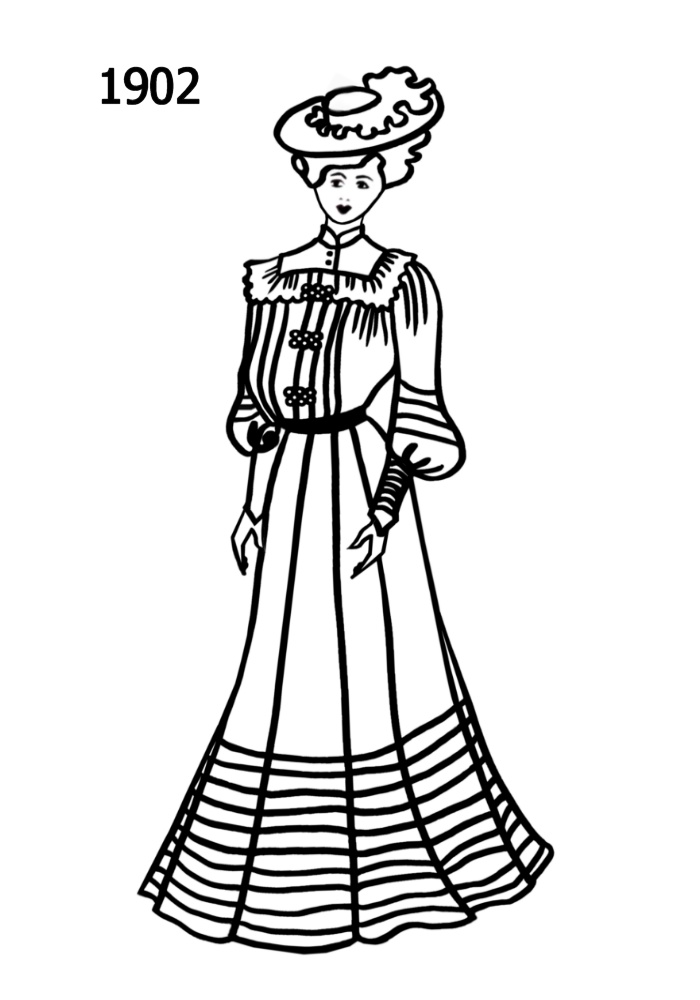
A lady dressed in the costume of 1902.

Apparent Danger to The Shooting Salvationist

Odd. This book, Apparent Danger, about Fort Worth Baptist preacher J. Frank Norris, has apparently been re-published under a different title, The Shooting Salvationist, with more publicity. I read the book last year, and I thought it was quite good, good enough that I included it in my Top Eight Nonfiction Reads of 2010.

Everything old (2010) is new again. Does this sort of thing happen often, a book being re-published (maybe re-edited?) under a different title?

1902: Books and Literature

Nobel Prize for Literature: Theodore Mommsen, German historian and author of History of Rome.

Fiction Bestsellers:
1. Owen Wister, The Virginian. I tried but was unable to conquer. Becky read it and loved it. Maybe I need to try again.
2. Alice Caldwell Hegan, Mrs. Wiggs of the Cabbage Patch. I have this classic on my Kindle, but I haven’t read it yet.
3. Charles Major, Dorothy Vernon of Haddon Hall.
4. Emerson Hough, The Mississippi Bubble.
5. Mary Johnston, Audrey.
6. Gilbert Parker, The Right of Way.
7. A. Conan Doyle, The Hound of the Baskervilles. I have read my Sherlock Holmes. I had a friend in high school who was mad about Holmes and Watson both.
8. Booth Tarkington, The Two Vanrevels. I’ve read Penrod and The Magnificent Ambersons, enjoyed them both, but not this one. Both Penrod (1914) and The Magnificent Ambersons (1918) are set during this time period, the first decade of the twentieth century.
9. Henry van Dyke, The Blue Flower. Short stories about the search for happiness by the author of The Other Wise Man and of the hymn lyrics Joyful, Joyful We Adore Thee.
10. Lucas Malet, Sir Richard Calmady.

Critically acclaimed and historically significant:
Jane Addams, Democracy and Social Ethics.
William James, Varieties of Religious Experience.
Joseph Conrad, Heart of Darkness
André Gide, The Immoralist
Vladimir Lenin, What is to be Done?
Henry James, The Wings of the Dove. Reading The Wings of the Dove by Elizabeth Gaffney at Salon.com.
Rudyard Kipling, Just So Stories
Beatrix Potter, The Tale of Peter Rabbit. Ms. Potter and I share a birthday, and so I wrote about her here. Go here for even more information about Beatrix Potter and Peter Rabbit.

Fiction Set in 1902:
Zora and Me by Victoria Bond. Fictionalization of the life of author Zora Neale Hurston from age nine to age eleven. In the book Zora becomes a girl detective who tries with her friends to figure out what happened to a man who was murdered or accidentally killed in their small Florida town.
Land of Promise by Joan Lowery Nixon.

American Eve by Paula Uruburu

American Eve: Evelyn Nesbit, Stanford White, the Birth of the “It” Girl, and the Crime of the Century by Paula Uruburu.

So, a photograph of Evelyn Nesbit was the inspiration for L.M. Montgomery’s description of the innocent, youthful, and inspirational Anne of Green Gables. And yet the true story of Evelyn Nesbit, The Girl in the Red Velvet Swing, is as sordid and debauched a tale as could be imagined. The contrast between the fictional character of Anne and the true character of young Evelyn Nesbit is heartbreakingly sad.

Evelyn Nesbit was born on December 25, 1884 (or maybe 1885). Her father died when she was ten or eleven, leaving the family in desperate straits. Young Evelyn managed to catch the attention of a newspaper photographer, then became a model for several artists in Philadelphia where the family was living in poverty, and finally moved with her mother and younger brother to New York where she became the most photographed young woman of the time. Photographers and artists stood in line to paint or take her picture. She was The American Beauty, the “It” Girl, Psyche, a Sibyl, the Sphinx, or “the glittering girl model of Gotham.” All this, and she was only sixteen years old.

And it all came crashing down, of course. One older New York millionaire seduced her, and another forced her into marriage and then defended her “honor” by murdering his rival on June 25, 1906 at the rooftop theater of Madison Square Garden. It was the Crime of the Century, and according to some, Evelyn Nesbit was completely responsible for the death of one man and the insanity of another. In her book about the drama, Ms. Uruburu takes the side of the underdog, Evelyn Nesbit. Everyone around Evelyn is described as “depraved” and “negligent” and “wicked”–all of which they probably were— but Evelyn is young and deceived and makes, not horrid, greedy choices, but rather “mistakes”. She is always trapped by her circumstances, unable to escape her fate, a victim of the manipulative, wealthy men and women who make her life into an obscene celebrity spectacle.

I thought the book was interesting in that it told a story that I have never read before. According to Uruburu, Evelyn Nesbit is a major character in E.L. Doctorow’s novel, Ragtime. I only made through about 100 pages of Ragtime, if that, and I never saw the movie based on the book. I also never saw or heard of the Joan Collins movie that was made about Evelyn Nesbit’s life, entitled The Girl in the Red Velvet Swing. As a defense of Evelyn Nesbit, the book succeeds for the most part, although her “mistakes” were a bit more culpable than the author wants to make them seem to be. It’s a mistake to find yourself unexpectedly alone with a married lecherous man; it’s a really bad choice to become the lecher’s mistress.

Warning: Some of the details of the story are lurid, and Ms. Uruburu’s prose gets a bit purplish at times. However, I doubt the author could have done much to sensationalize the story any more than it already was.

Evelyn Nesbit was definitely a sensation.

Earthquake at Dawn by Kristiana Gregory

Earthquake at Dawn is a book in the series Great Episodes, published in 1992 by Harcourt Brace. The novel is set before, during and after the San Francisco earthquake of April 18, 1906, and the story is based upon the stories of two real women who lived through the earthquake and its aftermath. Edith Irvine was a twenty-one year old photographer who was visiting San Francisco the morning of the earthquake. She hid her cameras in an abandoned baby buggy and took candid shots of the damage from the earthquake that San Francisco officials wanted to hide in an effort to reassure the public that the city was only slightly damaged and ready for more immigration and commerce. The other woman who appears in the book is Mary Exa Atkins Campbell who wrote a thirty-two page letter telling about her experiences during the earthquake and the subsequent fires caused, or at least exacerbated, by the damaged infrastructure and the lack of water.

It makes for a good story. Edith and her servant/friend, the fictional Daisy Valentine, wander about a ravaged San Francisco looking for Edith’s father. They meet up with not only Mary Exa, but also actor John Barrymore and author Jack London, who were actually present during the great earthquake and later wrote about their experiences, too. I always think that well-researched and engaging historical fiction is the most fun and memorable to learn history. You can get a general idea of what happened and how it affected the people involved in the event, and then if you’re interested, look more details for yourself. I especially like stories that are based on real-life characters like Edith Irvine and Mary Exa.

Go here to see some of Edith Irvine’s photographs of the earthquake’s aftereffects.

And here’s a movie made on Market Street in San Franciso just four days before the earthquake in 1906:

Only a couple of of these Great Episodes series books fit into my upcoming study of the twentieth century for this next school year:

Air Raid–Pearl Harbor!: The Story of December 7, 1941 by Theodore Taylor
Keep Smiling Through by Ann Rinaldi (1943)

What other historical fiction set in the twentieth century either for young people or for adults would you recommend?

Miss Pettigrew Lives for a Day by Winifred Watson

Published in 1938, Miss Pettigrew Lives for a Day is a book about grace and joy. Miss Pettigrew, a poverty-sticken, middle-aged, rather incompetent governess accidentally finds herself in the apartment of a promiscuous night-club singer, Delysia LaFosse. Even though Miss Pettigrew knows she should tell Miss LaFosse the truth, that she is there under false pretenses, and even though she knows the folly of Miss LaFosse’s way of life with men in and out of the apartment as if it had a revolving door, Guinevere Pettigrew can’t tear herself away from the first adventure that has ever presented itself in her entire life.

I found this one oddly delightful. Miss Pettigrew begins as the stereotypical repressed spinster, but she turns out to be surprisingly full of wisdom and intuition and zest for life. She just needs the right soil in which to grow and bloom, and Delysia LaFosse and her friends provide that avenue for growth. Delysia and her set are rather shocking in their behavior, but one gets the idea that they are more naive than calculating. And Miss Pettigrew is able, with her clear-sighted advice and her knack for saying the right thing at the right time, to straighten them out and make sure that the right man wins the hand of the fair lady and that the lady takes her chance when it is offered.

I’m rather skeptical about the movie based on this book. I think it would take a deft hand to keep the story from becoming a sexually titillating farce, and I see very little indication in the reviews that it didn’t become just that when Hollywood got hold of it. If I’m right, the book is much better.

Between Shades of Gray by Ruta Sepetys

Nominated for 2011 Cybil Awards, Young Adult Fiction category. Nominated by Lisa Schroeder.

Who was the greater monster: Adolf Hitler or Josef Stalin? This website says that Hitler was responsible for the death of about 12 million civilians while Stalin killed more than 20 million with his purges, executions, and repressive and ruinous policies. Who knows exactly? But one of the worst places to be would be caught between the two men and their armies and their insane, competitive desire for power. Lithuania in 1941, the setting for this novel, was in exactly that place: caught between the Nazis and the Stalinist Russians and crushed, co-opted, and destroyed by first one evil regime and then the other.

Fifteen year old Lina is preparing to go to art school when the NKVD comes to arrest her, her younger brother, Jonas, and her mother. Lina’s father has already disappeared, assumed to be arrested, and sent to some unknown prison. Or perhaps he’s dead, executed for the same unknown “crime” that causes the deportation of the rest of the family. What follows this beginning is a story as harrowing and cruel as any Jewish Holocaust story that you’ve read. Lina and her family starve, freeze, suffer, are mistreated, experience callous injustice, and barely survive their experience.

Author Ruta Sepetys is the American born daughter of a Lithuanian refugee. She wrote this story to “give a voice to the hundred of thousands of people who lost their lives during Stalin’s cleansing of the Baltic region.” Of course, this story, even though it is written to be representative of what happened to many Lithuanians during World War II, doesn’t tell the whole story. Some Lithuanians collaborated with the Nazis in opposition to the Russians. Some fought against the Soviet occupation. Some Lithuanians with ties to Germany fled to Germany during the first or second Soviet occupation of Lithuania. Some Lithuanians betrayed their neighbors to the NKVD or to the Nazis. Some Lithuanians saved their Jewish neighbors form the Nazis. It was a complicated and horrific time, and the book Between Shades of Gray reflects those complications. It is an excellent look into one family’s experience. Lina’s journey is based on interviews that Ms. Sepetys had with many Lithuanian survivors and their families.

Lithuania gained its independence from the Soviet Union on March 11, 1990.

1901: Music and Art

Music:
Richard Strauss: Feuersnot
Anton Dvorak: Rusalka
Scott Joplin: The Easy Winners Joplin had already had a hit in 1899 with the publication of the sheet music to his tune The Maple Leaf Rag. Over the next few years ragtime would become the most popular musical genre in the United States. Karate Kid, by the way, has been practicing The Maple Leaf Rag for a while, but he still doesn’t have it quite up to speed.

Art:
Nineteen year old Spanish artist Pablo Picasso presents his first exhibition in Paris in June, 1901.

Child with a Dove by Pablo Picasso, c.1901.

Child with a Dove, c.1901

1901: Books and Literature

Nobel Prize for Literature: Sully Prudhomme (Who?) French poet and essayist.

Fiction Bestsellers
1. Winston Churchill, The Crisis (not the British politician Winston Churchill)
2. Maurice Thompson, Alice of Old Vincennes
3. Bertha Runkle, The Helmet of Navarre
4. Gilbert Parker, The Right of Way
5. Irving Bacheller, Eben Holden
6. Elinor Glyn, The Visits of Elizabeth
7. Harold MacGrath, The Puppet Crown
8. Maurice Hewlett, Richard Yea-and-Nay
9. George Barr McCutcheon, Graustark
10. Irving Bacheller, D’ri and I

Critically Acclaimed and Historically Significant:
Frank Norris, The Octopus: A Story of California A fictional attack on the monopolistic stranglehold of American railroad tycoons over the business and life of the entire country.
E. A. Ross, Social Control. Ross was an American sociologist, eugenicist, political progressive, and supporter of the Bolshevik revolution in Russia.
Booker T. Washington, Up from Slavery
George Bernard Shaw, Man and Superman I read a lot of Shaw, including this play, back when I was in college, but I guess that I would find the humor and the ideas a lot more pernicious and at the same time superficial nowadays. I prefer Shaw’s arch nemesis and friendly combatant, Chesterton, these days.
George A. Gordon, New Epoch for Faith
Rudyard Kipling, Kim I tried to read this picaresque story of a British/Irish orphan boy who travels across India with a Tibetan mentor or guru, and eventually becomes involved in espionage as a small part of The Great Game. I just couldn’t make myself finish.
Anton Chekov, Uncle Vanya and The Three Sisters

Nonfiction set in 1901:
American Eve: Evelyn Nesbit, Stanford White, The Birth of the “It” Girl, and the Crime of the Century by Paula Ururburu. Recommended by Alyce at At Home With Books.

Fiction set in 1901:
Jocelyn, Marthe. Mable Riley: A Reliable Record of Humdrum, Peril, and Romance. (MG Fiction)
Turner, Nancy. These is My Words: The Diary of Sarah Agnes Prine, 1881-1901. (MG Fiction)
Death of Riley by Rhys Bowen. Recommended by Whimpulsive.

1901: Events and Inventions

January 10, 1901. Spindletop, the biggest oil well to date in the world, erupts, spewing a tower of oil nearly 200 feet into the air. The well will go on to produce 75,000 barrels of oil a day.

January 22, 1901. Queen Victoria of England dies at the age of 82. She was Queen of England and the British Empire from 1837 to the time of her death, for approximately sixty-four years. Her son Edward VIII becomes King of England.

January-July, 1901. Filipinos rebel against the U.S. occupation and annexation of the Philippine Islands, but on July 4th, William Howard Taft is installed as Civil Governor of the islands. General Arthur MacArthur, Military Governor since May 1900, sets sail for Japan.

Abraham Kuyper, b. 1837. Dutch pastor and theologian, he also becomes prime minister of the Netherlands in 1901: “Oh, no single piece of our mental world is to be hermetically sealed off from the rest, and there is not a square inch in the whole domain of our human existence over which Christ, who is Sovereign over all, does not cry: ‘Mine!’”

September 7, 1901. The Peking Treaty ends the Boxer Rebellion and gives huge commercial advantages to European and American interests.

September 14, 1901. William McKinley, the 25th President of the United States, dies eight days after being shot by anarchist Leon Czolgosz. His death was probably the direct result of a botched operation to remove the bullet(s) rather than being caused by the shooting itself. Vice-President Teddy Roosevelt becomes president.

December 10, 1901. The first Nobel prizes are awarded. Wilhelm Roentgen of Germany wins the Physics Prize for his discovery of X-rays.

December 12, 1901. Guglielmo Marconi sends the first ever telegraphic message across the Atlantic Ocean from the coast of England to Newfoundland, Canada.

Ping Pong fever swept Europe and the United States as families converted their tables into indoor tennis courts. The game, known as wiff-waff or Gossima at first, only caught on at about the same time that the name was changed by the manufacturer to Ping Pong. The first Ping Pong tournament was held in December, 1901.

PB&J: “The first located reference to the now immortal peanut butter and jelly sandwich was published by Julia Davis Chandler in 1901. This sandwich became a hit with America’s youth, who loved the double-sweet combination, and it has remained a favorite ever since…During the early 1900s peanut butter was considered a delicacy and as such it was served at upscale affairs and in New York’s finest tearooms.”