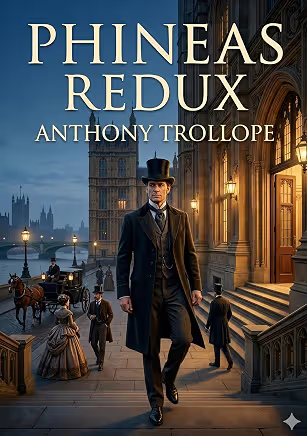
I read Trollope’s second Palliser novel, Phineas Finn, about an Irish Member of Parliament and his adventures in London, both romantic and political, back in 2025. If you follow the link to my review, you will see that I quite enjoyed the novel and became rather fond of Mr. Phineas Finn.
This summer I’ve been reading Phineas Redux, the fourth novel in the series. (In between is The Eustace Diamonds, a rather delightful read also, but one with no mention of Mr. Finn.) In his second novel appearance, Phineas Finn becomes an older and wiser man by means of a great sorrow and tragedy in his life. The novel itself is deeper and more fraught than Phineas Finn. Phineas must grow up and muddle through to maturity, whether he wants to or not.
Because Trollope always intended to bring Phineas back for a “redux”, the novel begin by killing off one of the minor characters in the first book, Phineas’s Irish wife, in order to enable Phineas to return to London and to political life in Parliament. The political issue of the day is the disestablishment of the Church of England, and Phineas must decide how he will campaign and vote on the bills brought forth in association with that issue.
Our hero must also decide how to deal with the women from his past, especially Mrs. Laura Kennedy, the woman he once loved who is now estranged from her husband but not free to love or marry anyone else. As much as I liked Phineas all through both books, I must say that I became heartily tired of Ms. Laura Kennedy and her incessant whining and weeping. I suppose that I might act the same way if I were trapped in a bad Victorian marriage, but I would hope not.
At any rate, Phineas can’t just tell Ms. Laura to get lost. Even though he is no longer in love with her, he feels an obligation to maintain a friendship with Laura and to offer what support and encouragement he can to her in her travails. And by doing so, Phineas becomes entangled in affairs and problems not his own that affect his political fortunes as well as his personal life and safety.
And Phineas’s “tangled web” is not the result of deception, but rather of honesty and his attempt to be kind and honest with all of his friends and associates. About halfway through the book, it turns into a murder mystery with Phineas as the main suspect in a brutal murder case. Although we readers know that Phineas is absolutely innocent of murder, the characters in the book are not blessed with our inside knowledge, and the plot revolves around how the various characters as well as Phineas himself manage the difficulty of being involved in a murder case.
I was struck by the similarities between politics in England in the nineteenth century and the politics of our place and time here in the U.S. The details and issues are different, but the empty political maneuvering and the eventual disillusionment with political life in general is that same. I was reminded of Ben Sasse and his conclusions after spending time in the Senate:
“I don’t really think our current politics are driving what’s happening. I think it’s mostly an echo of what’s happening. I think we have really thin, shallow community right now. And unless people know the thickness of their local community, it’s hard to make sense of what national politics are for.”
By the end of the book, Phineas Finn doesn’t really know what politics are for anymore. But he does learn a few things about his own life and purpose, however muddled, and those conclusions, plus the journey that Phineas makes to get to them, are worth the reading of the whole 600+ page novel.